Different formulations of entomopathogenic nematodes for the control of false codling moth
Different formulated EPNs for the control of false codling moth
DOI:
https://doi.org/10.21548/47-8222Abstract
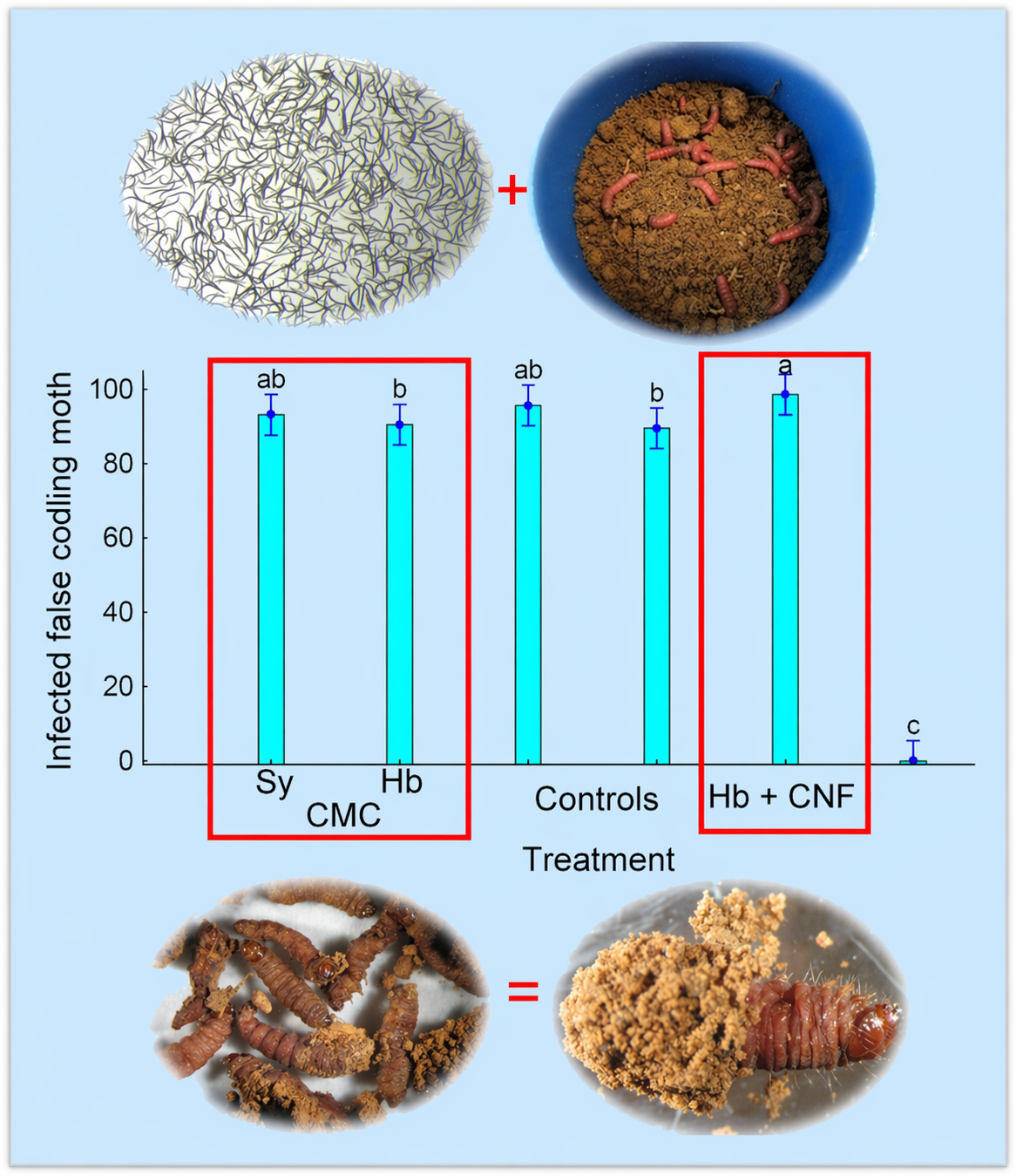
Most of previous research on entomopathogenic nematodes (EPNs) in South Africa has focused on the use of EPNs against false codling moth (Thaumatotibia leucotreta, FCM) in citrus orchards. However, in recent years, it has become evident that this pest has shifted to other hosts, with table grapes becoming an important concern in terms of export. No control measures in viticulture are currently directed at the soil-dwelling stages of FCM, presenting a niche that EPNs have the potential to fill. Despite significant progress in formulation techniques for EPNs, challenges such as limited shelf-life and microbial contamination remain problematic. In this study, locally sourced isolates of Steinernema yirgalemense and Heterorhabditis bacteriophora were produced through in vitro liquid culture and the shelf-life and pathogenicity of different formulations were assessed, along with the use of Xenorhabdus indica bacterial metabolites as a possible strategy to reduce microbial contamination. Results demonstrated that carboxymethylcellulose (CMC) and cellulose nanofibril (CNF) gel formulations enhanced the longevity of IJs, while maintaining virulence over time. Soil bioassays showed no differences in FCM larval pathogenicity between the formulated and unformulated nematodes, with an infection rate of > 90% after 48 h.
Downloads
Downloads
Published
How to Cite
Issue
Section
License
Copyright (c) 2026 South African Journal of Enology and Viticulture

This work is licensed under a Creative Commons Attribution-NonCommercial-NoDerivatives 4.0 International License.
A copyright form will be e-mailed to the corresponding author when the manuscript has been accepted for publication.
In principle, the Author agrees to the following when he/she signes the copyright agreement:
I hereby assign to the SOUTH AFRICAN SOCIETY FOR ENOLOGY AND VITICULTURE (SASEV) the copyright of the text, tables, figures, supplementary material, illustrations and other information (the Material) submitted with the manuscript to be published in SOUTH AFRICAN JOURNAL OF ENOLOGY AND VITICULTURE (SAJEV) (the "Article"). The copyright becomes effective from the date the Article has been accepted for publication in SAJEV.
This is an open access journal, and the authors and journal should be properly acknowledged, when works are cited.
Author's may use the publishers version for teaching purposes, in books, theses, dissertations, conferences and conference papers.
A copy of the authors' publishers version may also be hosted on the following websites:
- Non-commercial personal webpage or blog.
- Institutional webpage.
- Authors Institutional Repository.
The following notice should accompany such a posting on the website: This is an electronic version of an article published in SAJEV, Volume XXX, number XXX, pages XXX - XXX, DOI. Authors should also supply a hyperlink to the original paper or indicate where the original paper (www.journals.ac.za/index.php/sajev/) may be found.
Authors publishers version, affiliated with the Stellenbosch University will be automatically deposited in the University's Institutional Repository SUNScholar.
Articles as a whole, may not be re-published with another journal.
The following license applies:
Attribution CC BY-NC-ND 4.0